
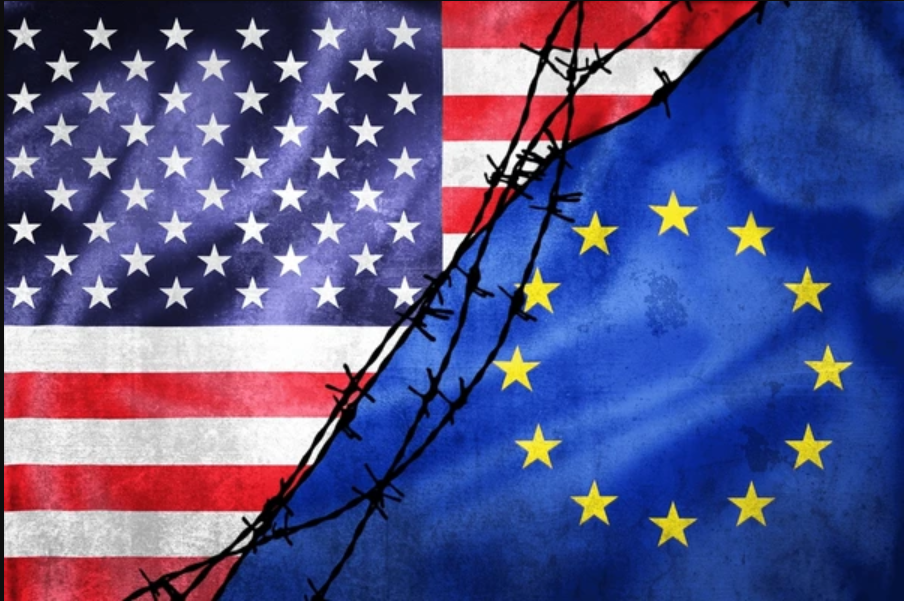
In one of the most dramatic shifts in modern transatlantic relations, Europe has taken what many analysts describe as its boldest economic step in decades — restructuring parts of its financial and trade architecture in response to escalating U.S. tariffs.
While headlines often focus on tariffs as tools applied to goods, the deeper story in 2026 has been about financial leverage, market access, and strategic autonomy. Europe’s response has not simply been retaliatory. Instead, it has signaled a long-term recalibration of its economic dependence on the United States.
The Trigger: Escalating Tariff Pressure
Following a new round of U.S. tariff increases targeting European exports — including industrial goods, automotive components, and select green technologies — policymakers in Brussels faced mounting pressure to respond decisively.
Rather than escalating with symmetrical tariffs alone, European leaders explored a broader set of tools. The logic was clear: modern economic power is not only about goods crossing borders, but about capital flows, financial clearing systems, regulatory access, and market integration.
From Trade Dispute to Financial Strategy
The European Union began accelerating policies aimed at reducing structural reliance on U.S.-linked financial infrastructure. These steps reportedly included:
- Expanding euro-denominated trade settlement systems
- Strengthening European capital market integration
- Encouraging EU-based financial clearing alternatives
- Reviewing regulatory access for certain U.S. financial institutions
Though not framed as a direct “cut-off,” the cumulative effect of these measures created what some analysts describe as a partial decoupling of financial ecosystems.
The message was strategic rather than emotional: Europe would not allow tariff pressure to translate into systemic vulnerability.
Strategic Autonomy in Action
For years, European policymakers have spoken about “strategic autonomy” — the ability to act independently in economic and geopolitical matters. The tariff dispute accelerated that agenda.
By promoting euro-based settlements in energy, commodities, and industrial trade, Europe sought to:
- Reduce exposure to dollar-denominated volatility
- Strengthen the global role of the euro
- Shield European companies from external political leverage
This was less about punishment and more about resilience.
Market Impact and Investor Reaction
Financial markets reacted cautiously. U.S. institutions with deep exposure to European capital markets faced uncertainty regarding regulatory alignment and cross-border access.
Meanwhile, European financial centers such as Frankfurt, Paris, and Amsterdam positioned themselves as hubs for expanded euro-clearing operations and cross-border capital flows.
While there was no full financial rupture, investors began reassessing assumptions about seamless transatlantic integration.
A Calculated Move, Not an Escalation
Importantly, Europe avoided framing its response as economic warfare. Officials emphasized stability, rule-based trade, and long-term institutional reforms.
This distinction matters.
Rather than imposing sudden prohibitions, Europe focused on structural shifts:
- Building internal capacity
- Diversifying partnerships
- Reinforcing regulatory independence
The strategy reduced immediate market shock while signaling seriousness.
Geopolitical Implications
The shift carries broader implications for the global economic order.
For decades, transatlantic financial integration formed a cornerstone of global markets. If Europe continues expanding autonomous financial mechanisms, it could:
- Accelerate multipolar financial architecture
- Increase competition between dollar and euro systems
- Encourage other regions to diversify away from U.S.-centric infrastructure
Some analysts argue this marks a subtle turning point in globalization — not fragmentation, but rebalancing.
Is This a Permanent Break?
Despite strong rhetoric, Europe has not fully “cut off” the United States from its financial markets. Trade and investment flows remain substantial. However, the psychological shift may be more important than immediate metrics.
The assumption of permanent financial interdependence has been challenged.
Tariffs, once seen as isolated trade tools, triggered a broader reconsideration of economic sovereignty.
The Bigger Picture
At its core, Europe’s response reflects a growing reality: economic security is now viewed as national security.
In a world of rising geopolitical competition, tariffs can act as catalysts for deeper structural change. Europe’s move was not merely defensive — it was transformative.
Whether this becomes a lasting realignment or a temporary phase will depend on future negotiations. But one thing is clear:
The era of automatic transatlantic economic alignment can no longer be taken for granted.