
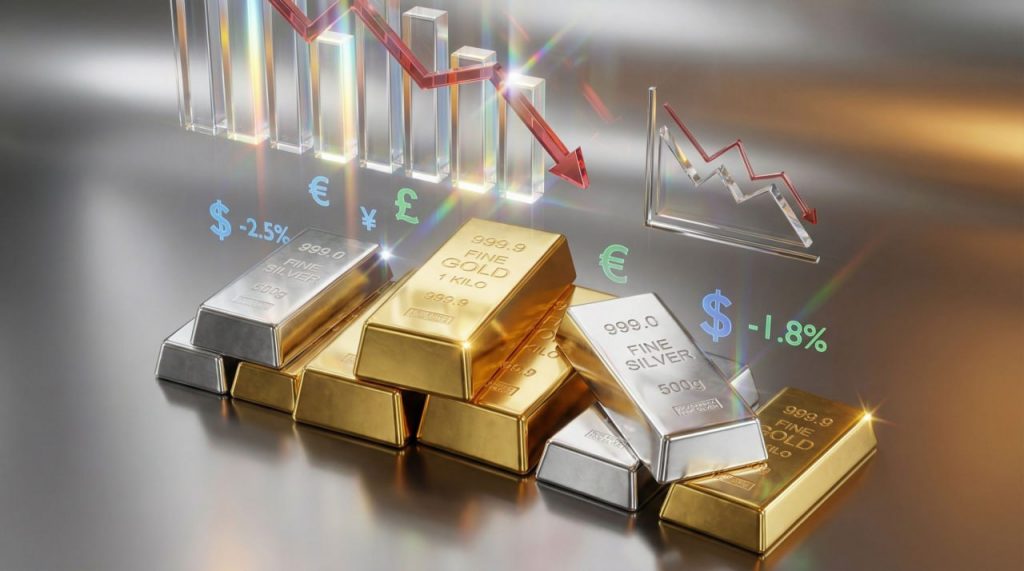
Over the past week, gold and silver markets have seen extreme price swings, with sharp declines followed by partial rebounds, capturing global investor attention and sparking intense speculation about underlying causes. Analysts point to a combination of fundamental market forces and speculative trading — not a single “platform launch” — as drivers of the recent moves.
🪙 Record Highs Followed by Rapid Pullbacks
Gold and silver reached historic price levels in early 2026 amid elevated safe‑haven demand — gold briefly trading above $5,500 per ounce and silver surging as demand spiked. But these gains were followed by some of the largest percentage price drops seen in decades, with experts describing the market as highly volatile rather than fundamentally broken.
📉 Sharp Selloff Triggers Market Reaction
On January 30 and February 2, precious metals experienced significant declines — nearly a 10% drop in gold pricing, its largest one‑day swing since the early 1980s, and large downturns in silver. Analysts attribute this to factors such as speculative position unwinding, increased margin requirements at futures exchanges, and profit‑taking by leveraged traders.
🧠 Analyst Takeaways: Short‑Term Pain, Long‑Term Resilience
Despite the sharp pulls, many market analysts remain optimistic over the medium and long term:
- J.P. Morgan maintains a bullish forecast, projecting that gold could reach around $6,300 per ounce by the end of 2026, driven by central bank purchases and investor demand for real assets.
- Other firms similarly forecast elevated pricing relative to historical levels, emphasizing gold’s role as a hedge against economic uncertainty.
This suggests that current volatility may be part of a broader price discovery process rather than a permanent collapse.
📊 Partial Recovery Signals Stabilization
After the downturn, markets have shown signs of stabilizing, with price rebounds helping to calm investors. On February 3, global markets saw precious metal prices bounce back alongside broader equity gains — evidence of renewed confidence among some market segments.
🔍 What’s Driving This Volatility?
Here are key real market drivers, according to analysts:
1️⃣ Macro‑Economic Uncertainty
Broader economic factors — inflation concerns, currency movements, geopolitical tensions and financial risk — continue to support safe‑haven interest in gold and silver.
2️⃣ Trading Structure & Speculation
A significant portion of the recent price moves appears linked to futures market mechanics — where margin rules and leveraged positions can amplify price swings in both directions.
3️⃣ Central Bank Demand
Despite temporary selloffs, central banks around the world have been consistently buying gold as part of reserve diversification strategies — a major bullish structural trend.
📰 Headlines the Market Really Supports
✔️ Gold and silver prices saw extreme volatility over recent days amid macroeconomic pressures and speculative trading dynamics.
✔️ Analysts continue to forecast higher prices by year‑end 2026 due to long‑term demand factors.
✔️ The recent downturn may be the result of market positioning and technical selloffs, not a “game‑changing platform launch.”
✔️ Partial rebounds in price indicate still‑strong interest from investors seeking diversification.
📈 What Investors Should Watch
Upcoming indicators that matter:
- Central bank gold buying data
- Futures market margin and open interest trends
- Global macroeconomic reports and inflation trends
- Supply dynamics in major producing regions
These will influence metals pricing far more than unverified narratives about new trading platforms or “mass wealth” schemes.